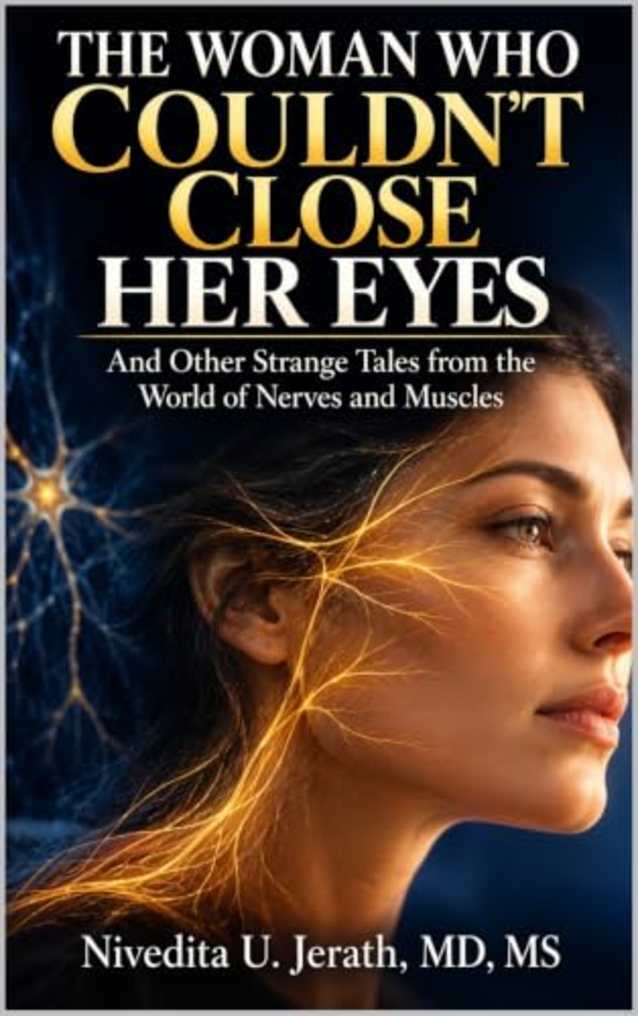
The Woman Who Couldn’t Close Her Eyes: And Other Strange Tales from the World of Nerves and Muscles (Neuromuscular Expert Series)
About
What happens when the body stops obeying the person who lives inside it?
A woman cannot close her eyes. A hand will not release its grip. Legs weaken for reasons no one can immediately explain. Ordinary acts—walking across a room, swallowing, breathing, smiling, lifting an arm—suddenly become clues.
In The Woman Who Couldn’t Close Her Eyes, neuromuscular neurologist Nivedita U. Jerath, MD, MS, takes readers inside the remarkable world of nerves and muscles through a collection of medical mysteries.
Each story begins not with a diagnosis, but with a human problem: something strange has happened to the body. From there, readers follow the clues alongside the physician—learning how neurologists use the pattern of weakness, sensation, reflexes, electrical testing, imaging, laboratory studies, genetics, and sometimes muscle or nerve biopsy to discover where the body’s communication system has gone wrong.
Along the way, complex neurological diseases become understandable through the lives they disrupt. The book explores disorders of peripheral nerves, muscles, motor neurons, the neuromuscular junction, and the immune system while revealing the extraordinary biology behind movements most of us never think about.
But this is more than a book about rare diseases.
It is a book about what the human body can teach us when something stops working.
Why can a person think perfectly clearly yet be unable to move? Why can an immune system attack the nerves it is supposed to protect? Why does losing sensation sometimes make walking nearly impossible? Why can the smallest failure in a microscopic connection change an entire life? And how do physicians solve these mysteries when the first tests do not provide an answer?
Written for patients, families, medical professionals, students, and anyone fascinated by the mysteries of the human body, The Woman Who Couldn’t Close Her Eyes combines clinical detective work, accessible neuroscience, and human stories to reveal an invisible electrical system working beneath every movement we make.
After reading it, you may never look at something as ordinary as blinking, standing, walking, smiling, or holding someone’s hand quite the same way again.