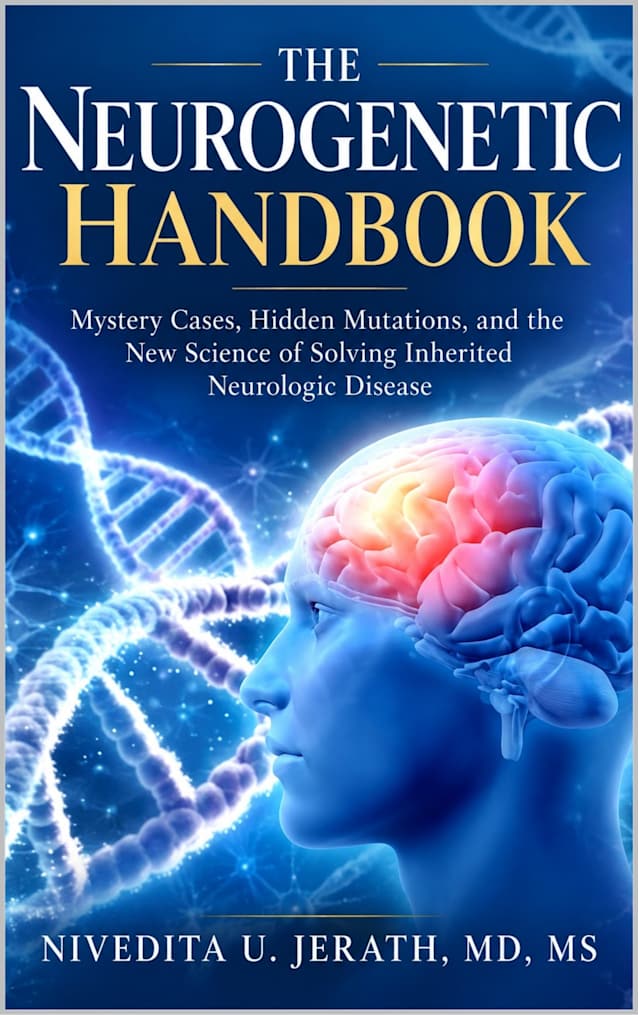
THE NEUROGENETIC HANDBOOK: Mystery Cases, Hidden Mutations, and the New Science of Solving Inherited Neurologic Disease (Neuromuscular Expert Series)
About
What if the clue to a mysterious neurologic disease isn’t hidden in another test—but in the pattern everyone has overlooked?
A man falls for eleven years before anyone asks about his cough. A woman discovers that the genetic mutation she fears does not explain her symptoms. A family thinks generations of “bad ankles” are simply bad luck. A patient carries a diagnosis that explains almost everything—until one stubborn clue refuses to fit.
Welcome to the detective work of neurogenetics.
In The Neurogenetic Handbook, neuromuscular neurologist Nivedita U. Jerath, MD, MS, takes readers inside the reasoning used to solve some of medicine’s most fascinating inherited neurologic mysteries.
The book begins with a simple principle:
Every rare disease is rare. The clues that reveal it are not.
Rather than asking readers to memorize hundreds of genes and syndromes, Dr. Jerath teaches them how to recognize patterns. Where is the weakness? Are the reflexes absent or unusually brisk? Does sensation disappear? Do the eyes, heart, hearing, or feet reveal something the laboratory missed? Does the family tree contain a diagnosis no one recognized as one?
Through memorable clinical mysteries and accessible explanations, readers discover how neurologists move from symptom to localization, localization to inheritance, inheritance to genetic testing, and genetic testing to diagnosis and increasingly to treatment. The manuscript itself describes this as a chain of reasoning from phenotype through localization, inheritance, testing, variant, mechanism, and treatment.
Inside you’ll explore:
- Why a negative genetic test may not end the search
- How the distribution of weakness can point toward its cause
- What reflexes, high arches, hearing loss, eye movements, and family history can reveal
- Why a variant of uncertain significance is not a diagnosis
- How neuropathies, muscular dystrophies, motor neuron disorders, ataxias, mitochondrial diseases, and other inherited conditions can masquerade as one another
- Why the same gene can produce dramatically different disease
- How repeat expansions, mitochondrial inheritance, mosaicism, penetrance, and other genetic phenomena complicate the detective work
- What happens when two genetic diagnoses are both correct
- How to read a genetic report without panicking
- How gene replacement, RNA therapies, gene silencing, exon skipping, protein replacement, and gene editing are changing diseases once considered untreatable
At its heart, The Neurogenetic Handbook is not a catalog of rare diseases. It is a book about how to think when the diagnosis doesn’t make sense.
Because sometimes the answer isn’t hiding deeper in the chart.
Sometimes the clue has been in front of us all along.