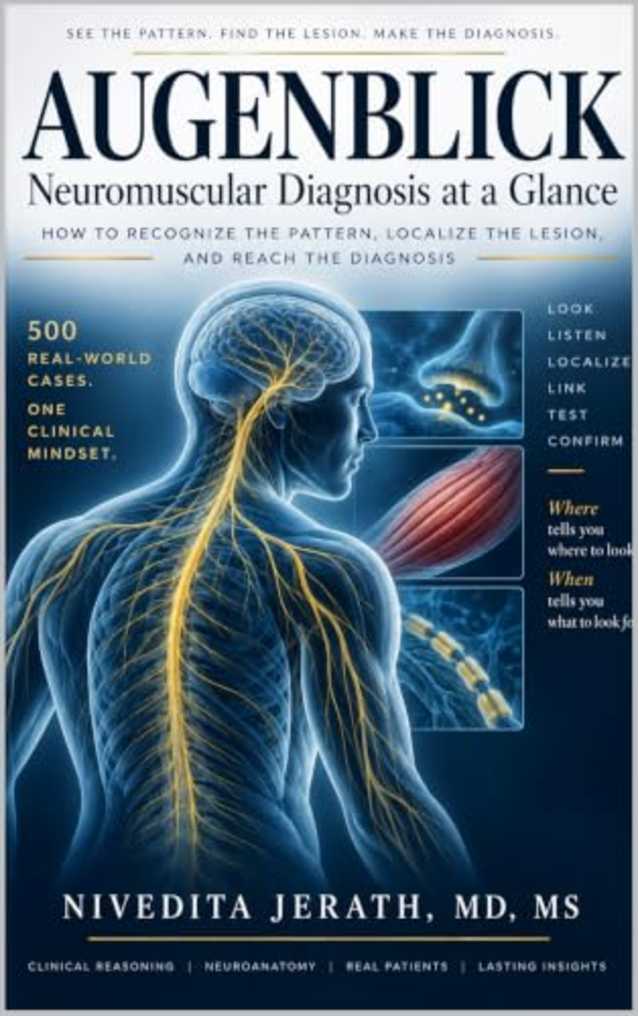
Augenblick: Neuromuscular Diagnosis at a Glance — How to Recognize the Pattern, Localize the Lesion, and Reach the Diagnosis (Neuromuscular Expert Series)
About
500 Cases. One Clinical Mindset. The Art of Seeing What Others Miss.
What if the key to a difficult neurological diagnosis is hidden in the first few moments of a patient encounter?
A subtle change in gait. A missing reflex. An unusual pattern of weakness. A patient who cannot climb stairs, lift an arm, or maintain balance.
To the untrained observer, these may seem like unrelated symptoms. To an experienced neurologist, they can reveal the location of disease—and sometimes the diagnosis itself.
In AUGENBLICK: Neuromuscular Diagnosis at a Glance, neurologist Nivedita Jerath, MD, MS, takes readers on an extraordinary journey through 500 clinical cases that illuminate the art and science of neuromuscular diagnosis.
Blending medical mysteries, neuroanatomy, clinical reasoning, and diagnostic problem-solving, AUGENBLICK transforms complex neurological presentations into memorable lessons in pattern recognition.
Rather than relying on endless memorization, readers learn to approach neurological disease through a disciplined process: observe carefully, recognize the pattern, localize the lesion, consider the possibilities, and select the tests that matter.
Inside this book, discover how to:
Recognize the pattern: Identify the clinical clues that distinguish neurological weakness from fatigue, pain, and other causes of impaired function.
Localize the lesion: Determine whether symptoms arise from the spinal cord, nerve root, plexus, peripheral nerve, neuromuscular junction, or muscle.
Interpret the examination: Understand the diagnostic significance of reflexes, muscle tone, sensory findings, gait abnormalities, and distributions of weakness.
Solve neuromuscular mysteries: Work through cases involving neuropathies, myopathies, motor neuron disorders, neuromuscular junction diseases, and other challenging presentations.
Choose meaningful investigations: Understand how electrodiagnostic testing, laboratory studies, imaging, muscle biopsy, and genetic testing contribute to diagnosis.
Avoid diagnostic pitfalls: Recognize misleading presentations, competing explanations, and the importance of revisiting an initial diagnosis.
Build clinical intuition: Develop a systematic approach that makes complicated neurological problems easier to understand and remember.
Every case is an opportunity to think like a neurologist.
A patient presents with progressive weakness. Is the problem in the muscle or the nerve?
Another experiences numbness and difficulty walking. Is the pattern consistent with a peripheral neuropathy, radiculopathy, or spinal cord disorder?
A third has fluctuating weakness and an examination that changes with repeated effort. What does this reveal about neuromuscular transmission?
Through hundreds of diagnostic challenges, readers are invited to follow the clues, consider the differential diagnosis, and understand the reasoning behind the final answer.
Designed for medical students, neurology residents, fellows, practicing clinicians, and lifelong learners, AUGENBLICK provides an engaging approach to mastering the clinical foundations of neuromuscular medicine.
The most valuable diagnostic skill is not knowing every disease. It is knowing what to notice, where to look, and how to think.
See the pattern. Find the lesion. Make the diagnosis.